
Gun Force story
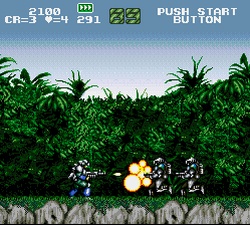
GunForce has that rare whiff of arcade cordite that never really fades. It started life as a purebred Irem coin-op—CRT glare, bezel glass, panel decals, the clink of quarters, and short, staccato bursts from pixel guns. In the roar of a packed arcade, this run-and-gun was born—nervy and straight as a machine-gun burst. The cabinet wore a proudly overlong title—Battle Fire Engulfed Terror Island—so around here it sometimes passed as “GunForce: Terror Island,” but most folks just said “GunForce.” When Irem hauled it over to the Super Nintendo, the spirit stuck: run, fire, metal, flash. The SNES home port brought that same adrenaline to the living room—no tokens, no stern floor attendant.
How Irem caught the wave
By the early ’90s, Irem had a reputation. After R-Type, the studio knew how to do tough, fair arcade action, and GunForce on SNES feels like a continuation of that school. The team loved building stages that kept you on the edge—step left, step right, dive, dash—and every decision snapped like a gunshot. In the arcade it was tuned around credits and continues: die, feed the slot, jump back in. But unlike a lot of Contra-likes of the era, GunForce had a grip thanks to its staging: scorched warzones, half-collapsed bridges, and “hardware”—choppers, armored trucks, mounted turrets. A dry, wordless post-apocalypse where pixels sold the story better than a dozen cutscenes.
The devs weren’t shy about cinematic flair: ziplines over chasms, quick motorcycle runs under a wall of lead, boss fights where the machinery felt alive—huge mechs and walkers grinding out of cover with a screech. That was the spectacle you lined up for. And Irem was already drifting toward what would later bloom into Metal Slug: crisp hitboxes, expressive sprites, that tactile sense of “living” steel. No wonder fans later called GunForce a precursor to the series.
Onto the cartridge
The Super Nintendo port was a compromise—but an honest one. The “home” version kept the arcade’s frayed nerves and that clean line of fire people loved GunForce for. The soundtrack morphed into a chiptune set with that unmistakable Irem heft—snappy drums, thick bass—and even over composite on a living-room TV the groove felt right. Sprite animation got simpler, but the stages stayed streamlined with clear checkpoints. The difficulty stopped demanding a fistful of coins—on a cartridge, checkpoints brought you back out of stubbornness, not despair.
Co-op was a hot topic: the game’s arcade DNA is two players shoulder to shoulder, pouring fire into the screen. On SNES, plenty of folks tackled GunForce together—taking turns, trading quips on the couch, riding that “one more run” buzz. Different regions, PAL and NTSC, different boxes and stickers—but the emotion landed the same: press Start, short inhale, and back into the thunder. Irem America got it onto shelves, while in our neck of the woods the cart often rolled in via rentals and retro shops, where GunForce shared rack space with other 16-bit staples.
Why it stuck
This run-and-gun never pretended to be more than it was. You slipped into the tempo, learned enemy recoil tells, felt a boss’s reload rhythm, and a couple stages in you could hear where the next rocket was coming from. Sound design fed the mechanics: the little “pfft” of grenades, the heavy thump of mounted guns, a background roar like a fuel depot burning nearby. The context—Terror Island, civilian evacuations, the apocalypse by implication—peeked out through wall posters and warning strobes. No dialogue, no subtitles, yet an atmosphere magazines like Famitsu and the western press kept passing around, comparing it to Contra and nodding at that signature Irem cadence.
Visually, GunForce is pixel art without luxury but with clean geometry. Angular ruins, creases in armor, muzzle flashes that glow a touch softer on SNES than in the arcade but still hit the eye. It’s hard to forget the first volley into a late-stage armored “tin can,” when the screen whites out for a beat and then the burning chunks resolve. Even now, watching playthroughs and speedruns, the kinetics feel dialed in: the hero takes a short step, glances up, snaps onto a ladder—all without float or mush in the controls.
A mark on the genre
After GunForce, Irem stayed the course. Arcades thundered with GunForce 2 (aka Geo Storm), and part of the team later formed Nazca and delivered Metal Slug to the world. The connection’s obvious without a spreadsheet: love for machines, obsessive detail, readable, honest challenge. For many players, GunForce was the bridge from the token-stuffed arcade to the couch and a pad: first coins and continues, then a cartridge, long evenings, and restarts till you nailed it. And while the box usually just said plain old GunForce, conversation kept reviving that “Terror Island” tag—the flavorful aftertaste of the arcade era, where every mission felt like an evacuation through fire.
Years on, GunForce for SNES is still the game you revisit for straight, no-BS action. Not for dates and trivia, but to hear that crackling chiptune again, feel the tempo ramp, and remember why we fell for run-and-guns back when sprites flickered and your thumbs shot straight for Start and Fire.