
Gun Force Gameplay
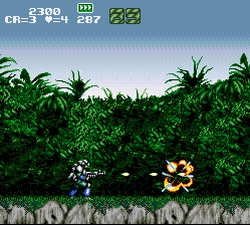
In Gun Force you’re thrown into the grinder from second one—chopper drops you on the beach, depots are ablaze, and the timer’s already ticking like the island’s heartbeat. No warm-ups: first dash, first burst, first miracle dodge. This run-and-gun on the SNES isn’t about careful baby steps; it’s about rhythm. You keep tempo like a marching-line drummer: hop — volley — slide into cover — push again. And the tighter the time limit squeezes, the more the ground itself seems to shove you toward the next screen. In GunForce, stalling is fatal. Pause for a beat and a sea of fire rolls over you while you line up a diagonal shot at a balcony gunner.
The pace a stage breathes in
Every locale breathes its own beat. On the pier, GunForce teaches you to jump in short measures: crates, scorched boats, ladders—you thread them between the claps of explosions. A little farther, the screen opens up, and long sprints suddenly make sense as armor barrels in and helmeted grunts scatter. That’s when the inner dialog with the timer kicks in: “Can I cut across the ropes? Dare to slip under the turret?”—and your hands choose a jump over an extra shot. In Gun Force: Battle Fire Engulfed Terror Island there’s no big pause to think; choices are made on the run, pure adrenaline, when your shoulder feels a bullet graze past and your headset seems to hear the boss gears grinding before the camera even reveals it.
Guns that change your stride
The base rifle is infinite, but it doesn’t give the kind of confidence this island demands. Snag a pickup and your gait changes instantly. The laser slices corridors like a heated wire, and you push up close, almost whistling. The flamethrower hisses back, and you hold distance, denying every boarder a step. The spread gun turns you into a mobile broom: side angles clear, ladders get safer, jumps get tighter. A couple of seconds—and you’re a new version of yourself. Lost in the blaze? Grab the H-module, plant your feet, and feel the shooter in you turn to stone. Gun Force doesn’t make you cram a spreadsheet of stats, but it nudges you: “Take the laser here—it’ll walk you through the hangars; save the flamethrower for those canister-packed tunnels.” Nail the pickup, and the stage just flows, delivering that retro satisfaction like a puzzle clicking into place.
Machines and risk—a sweet pairing
The biggest grins in Gun Force start the moment you spot hardware. A jeep with a turret is a mini-holiday, a chance to breeze through with the wind in your face. Hop in and let it rip: smoke, chunks of pixel steel, a hurricane of brass. But every vehicle is a deal with the devil: you’re louder, easier to box in, and any hesitation gets punished. The motorcycle runs on a different cadence—staccato bursts; you feel the track in your shoulders, like you’ve slipped into another game for a heartbeat. You crash into hangars, saw crates with the laser, shower sparks over fixed guns, and then—jump off at the perfect second! That’s the rush. GunForce constantly dares you to be cocky: “Can you duck under the bridge on the bike? Will you mount the fixed MG under a squall?” Nail it, and it feels like winning a duel without a single extra word.
Co-op—synchrony without chatter
Two players here aren’t just “more fun.” Co-op reshapes the whole thing. One holds the high lane, the other wipes the low, and the scroll practically squares its shoulders. You get that side-on squad-shooter vibe: a hand flick and your partner already knows to cover the ladder while you slide into the gunner’s seat. Helicopter boss? One chews its tail with spread while the other carves the hatch with a laser where the boarders spawn. No need to discuss who grabs the upgrade—GunForce settles it with rhythm. You see positions, and like a tight band on stage, you read each other in the rests. Two-player co-op here isn’t a bonus—it’s almost canon, the reason so many slammed the cart in at night so they wouldn’t wake the neighbors.
Bosses and big gestures
Level finales are little stage plays. A tank behemoth crushes platforms like cardboard. Your pulse thumps in your fingers as you, almost by ear, feel out safe windows for diagonal bursts. Or the rotor starts pulling air—as the chopper enters with a belly full of fire. GunForce plays fair: bosses have readable phases, moments you can feel—“now.” And when that two-second window lines up with your jump and a short spray, it’s pure arcade magic. You didn’t cheese it—you hit the groove. That’s why people replay GunForce—hunting the clean run with no wasted hits and a timer that freezes on the last tenth.
Small things that become muscle memory
This game loves anchors. Short ropes that shave off seconds; ladders that feel so good to “roll” a spread through; brittle barrels that turn a corner into a sea torch; those exact points where a risky roll beats a shootout. There’s rescue too—you’ll find civilians, and scooping them up feels like paying the level back for all that metal and fire. Checkpoints spark their own goals: “stretch it without a continue,” “squeeze out more points,” “clear it on one weapon.” This kind of arcade shooter doesn’t imprint with cutscenes, but with habits in your hands: how you enter a hangar, what height you land on a platform, when you ease off the trigger so your spray doesn’t stitch the ceiling. It’s a side-scrolling shooter you live through your body.
And when, on your last breath, the timer silently threatens zero and GunForce keeps barreling forward—you feel the game guide you without stealing your freedom. It lets you choose: carefully carve a path or ride the gunlines, catching moments. On an island engulfed in flames there’s no “right” route—only yours, the one you’ll return to just to do it better. That’s why GunForce stays special: the warm glow of familiar arcade, a pulse at your fingertips, and the endless hunt for the perfect tempo—where every explosion isn’t just VFX, but a sign you’re doing it right.